Аз не бях чувал тази версия, честно казано - малък Кувейт щял да фалира Ирак за няколко месеца? Икономически и се струва неиздържано. Къде са другите нефтопроизводители в картинката?
Не знам какво си чувал и какви източници четеш, ама това е основната версия , ето какво казва самия Саддам по въпроса :
http://m.gulfnews.com/saddam-states-rea ... n-1.502105
Shortly after his arrest in December 2003, former Iraqi president Saddam Hussain was interrogated by the FBI.
The secret interrogation documents, which were made public only recently by the National Security Archive, an independent non-governmental research institute in the US, shed light on the state of mind of Saddam, executed in December 2006.
According to Saddam, Ayatollah Khomeini and Iran would have occupied all of the Arab world if it had not been for Iraq. As such, Iraq expected the Arab world to support them during and after the war.
However, Iraq saw the opposite regarding support, especially from Kuwait. At the end of the war as Iraq began the rebuilding process, the price of oil was approximately $7 (Dh25.71) per barrel.
In Saddam's opinion, Iraq could not possibly rebuild its infrastructure and economy with oil prices at this level. Kuwait was especially at fault regarding these low oil prices.
In an effort to solve the situation and stimulate economic recovery, Iraq sent Dr Sa'doum Hammadi, Iraqi Minister of Foreign Affairs to Kuwait.
Hammadi, and the Iraqi leadership's conclusion after the meeting was that the oil price situation was not just the responsibility/work of the Kuwaitis. Iraq believed some other entity, some larger power was behind this 'conspiracy'.
Iraq also sent government officials to Saudi Arabia to convince the Saudis to pressure Kuwait. In addition, the Saudi oil minister came to Iraq and held talks about oil prices, the Iraqi economy, and the actions of Kuwait.
Saddam claimed that a Kuwaiti official said, "We'll make the economy in Iraq so bad, one would be able to sleep with an Iraqi woman for ten dinars." Saddam told the Saudis that if Kuwait did not stop interfering in Iraqi affairs, he would make the Kuwaiti dinar worth ten fils.
Saddam stated that when Kuwait was faced with the facts regarding "stealing Iraqi oil using the practice of slant drilling, they admitted to having taken only two and a half billion barrels." They stated this fact as if it was not significant.
Regarding the problems with Kuwait, Iraq sent delegates to other Gulf countries which Saddam does not remember. These delegates explained the Kuwaiti situation and the Iraqi situation.
The other countries promised to correct oil prices at the next meeting of the Organisation of Petroleum Exporting Countries (Opec).
At the next Opec meeting, a decision was made to fix the oil price at $16-17 per barrel, as remembered by Saddam Kuwait concurred with this decision.
Thereafter, the Kuwaiti Minister of Oil or Minister of Foreign Affairs stated Kuwait would not abide by the Opec decision.
Regarding loan debts owed to Gulf countries as a result of support received during the Iran-Iraq War, Saddam stated these were not loans and were supposed to be free aid from these countries.
The countries had originally used the word "loan" as a formality only to disguise the purpose of the funds from Iran. When Iraq was informed the money was actually from loans, Iraq held discussions with these countries, including Kuwait, in order to resolve these debts.
---
Prior to the invasion of Kuwait, Saddam stated there was a meeting of the Iraqi Revolutionary Command Council (RCC) in which a discussion of the matter took place.
The Iraqi leadership of the RCC had hoped the Saudis would "interfere" and have a solution. The Deputy Chairman of the RCC had travelled to Saudi Arabia to solicit their assistance but returned without success.
Thereafter, the matter could only be discussed and decided upon in favour of military action. Saddam acknowledged the possibility that one or more RCC members opposed or voted against the invasion, but he does not specifically remember any such opposition. He does not remember if a majority or all of the RCC members agreed on military action.
Saddam stated, "I was against attacking if a solution could be found." The last attempt at reaching a solution occurred during the previously referenced visit to Saudi Arabia in which the Deputy Chairman of the RCC met with the brother of Kuwaiti leader Shaikh Sabah.

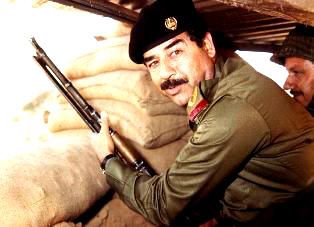
 Колко пъти каза "Алах е велик", иначе уж бил светски диктатор.


 Ами пазар е това, нормално е производителите на един и същ продукт да са конкуренти.