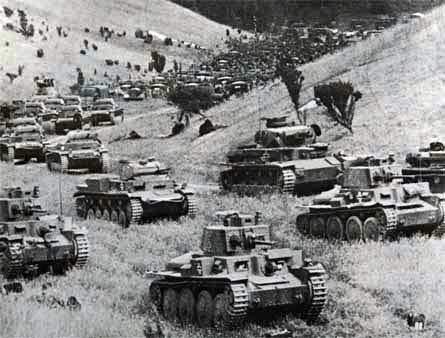
Малко хронология на събитията около Дюнкерк, извадил съм най-важното. В крайна сметка в два от решаващите дни и лошото време помага на англо-французите да спасят повече хора, предотвратявайки немски бомбардировки, но все пак има такава директива на Хитлер:
24 May 1940 German troops captured Ghent and Tournai, Belgium.
24 May 1940 In France, the German 10th Panzer Division began an attack on Calais and captured the town of Boulogne (capturing 5,000 Allied troops), Maubeuge, and Saint-Omer. To the north, the German 1st Panzer Division reached the Aa Canal 10 miles from Dunkerque in an attempt to cut off the Allied troops in Belgium.
At this key moment, Adolf Hitler interfered and ordered the tanks to pull back; he was promised by Hermann Göring that the Luftwaffe would be able to prevent the Allied evacuation from taking place; German Army generals protested, but to no avail. - Гьоринг Дебелото е поизлъгал Фюрера.

25 May 1940
Adolf Hitler continued to hold off his tanks from engaging on an offensive even though those armored division were merely 10 miles from Dunkerque, France. At Calais, France, Heinz Guderian obediently, albeit frustratingly, ordered his tanks to halt per Hitler's orders, but the field commanders continued to push back the British and French troops. In the evening, British Expeditionary Force commanding general Lord Gort began to fall back to Dunkerque. On the same day, the French Army relieved 15 generals of their commands.
26 May 1940 At Dunkerque, France, British Expeditionary Force commanding general Lord Gort received the formal authorization for a withdraw; Operation Dynamo, the code name of the massive evacuation, was headed by British Admiral Sir Bertram Ramsey. Meanwhile, Adolf Hitler rescinded the order to halt the offensive near Dunkerque. At Calais, after a heavy aerial and field artillery bombardment, German troops crossed the canals and moved toward the Citadel; at 1600 hours, Brigadier Claude Nicholson surrendered. Elsewhere, the French 1st Army was nearly encircled by the Germans, while the Belgians was pushed back to the Leie/Lys River.
27 May 1940 German tanks and aircraft maintained pressure on the Allies in France, pushing them back four miles toward the coast and placing Dunkirk within artillery range; meanwhile, the first 7,669 British troops were evacuated from Dunkirk.
28 May 1940 In France, 11,874 Allied personnel were evacuated from Dunkerque harbor and 5,930 from the nearby beaches; the latter was possible due to the arrival of many small fishing boats and pleasure craft. At Lille, seven German Divisions trapped the 40,000-strong French First Army. At Abbeville, the crew of French Char B1 Bis tank "Jeanne d'Arc" gallantly fought on against a German attack despite receiving 90 hits. Across the front lines, between eighty and ninety British prisoners of the 2nd Warwickshire Regiment, the Cheshire Regiment, and the Royal Artillery were murdered by members of No. 7 Company, 2nd Battalion SS Liebstandarte at Wormhoudt, France.
29 May 1940 Allies evacuated 33,558 men from the harbor at Dunkirk, France and 13,752 from the nearby beaches. German aircraft interfered, attacking ships in the sea as well as men waiting on the docks. Destroyer HMS Grenade was hit by three bombs, one of which went down her funnel, in Dunkirk harbor and sank, killing 19. Destroyer HMS Jaguar was badly damaged by a bomb, killing 13 and wounding 19. Minesweeper HMS Waverley, with 600 troops already aboard, was sunk by a bomb, killing 350.
30 May 1940 The British Admiralty ordered all modern destroyers to leave Dunkirk, France due to the previous day's losses by German Luftwaffe, leaving 18 older destroyers to continue the evacuation; 24,311 were rescued from the harbor and 29,512 were rescued from the nearby beaches on this date.
31 May 1940 Poor weather clouded over Dunkerque, France, giving the British a chance to bring in modern destroyers into the area to assist the evacuation with less fear of German air attacks; 68,014 (45,072 from harbor and 22,942 from beaches) were rescued on this date, including British Expeditionary Force commanding general Lord Gort. French destroyer Leopart and British destroyers HMS Express.
1 Jun 1940 Overnight, British troops pulled out of the defensive line around Durkirk, France and headed for the ships, leaving French troops to hold a reduced perimeter. After day break, German bombing sank French destroyer Le Foudroyant (killing 19), British destroyers HMS Basilisk (killing 9; scuttled by destroyer HMS Whitehall), HMS Havant (killing 8, scuttled by minesweeper HMS Saltash), and HMS Keith (killing 36).
2 Jun 1940 Due to costly air attacks, British Admiralty decided that evacuation from Dunkirk, France would only be undertaken at night, particularly because nearly all British troops had already left Dunkirk by this time. On this date, 19,561 troops were evacuated from the harbor and 6,695 from the beaches.
3 Jun 1940 The last group of British troops at Dunkirk, France was evacuated before the break of dawn. At 1050 hours, Royal Navy Captain William Tennant signaled the completion of Operation Dynamo, but he was overruled by this superiors as there were still some French troops in Dunkirk. During the day, the British Admiralty acknowledged that 222 British naval vessels and 665 other craft were employed for the Dunkirk evacuation; 6 destroyers, 24 small armed vessels, and 226 other ships were lost. British ships returned to Dunkirk after night fall. By this time, German troops were only 2 miles away.
4 Jun 1940 Overnight, 26,175 French troops were evacuated from Dunkirk, France. At 1020 hours, German troops occupied the city and captured the 30,000 to 40,000 French troops, 2,000 British field guns, and 60,000 British vehicles. In total, 338,226 Allied personnel were evacuated through Operation Dynamo.